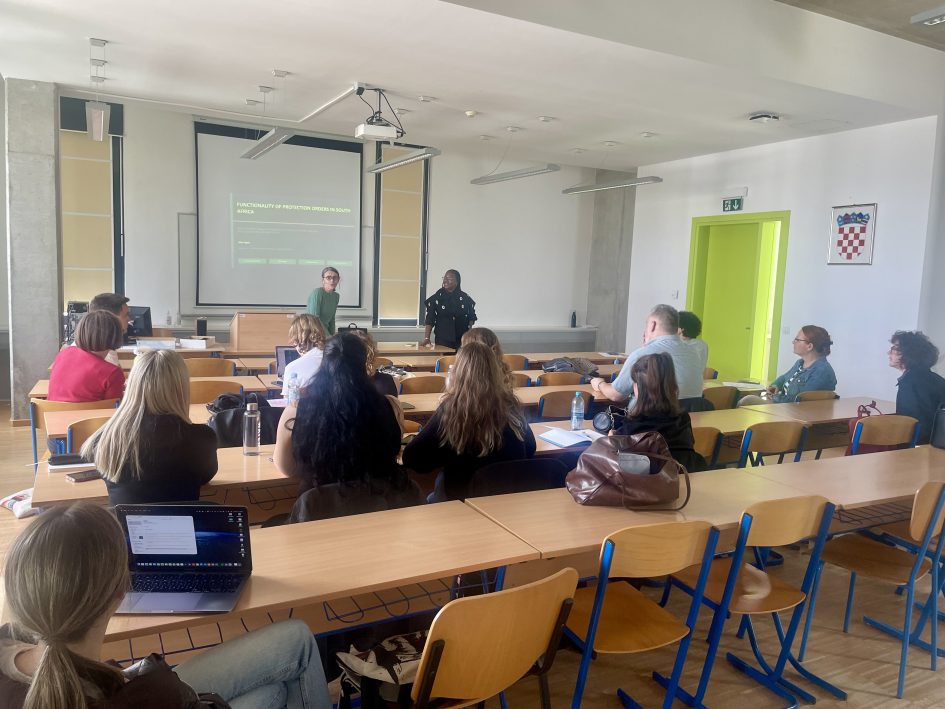
On 20 April, the Centre for Women’s Studies organised a mini-colloquium entitled “Functionality of Protection Orders in South Africa: Safety Challenges Survivors of Intimate Partner Violence Face Post-Shelter Admission and Implications for Social Work Practice”, featuring a guest lecture by Dr Mabebe Mary Kgole from the University of Pretoria.
Dr Mabebe Mary Kgole is visiting Rijeka as part of the cooperation between the University of Pretoria in South Africa and the Faculty of Humanities and Social Sciences in Rijeka under the Erasmus+ KA171 programme. She delivered the lecture as a guest speaker on the course Gender and Sexual Identities.
Speaking to students, colleagues from the organisation UZOR, the Gender Equality Council of the University of Rijeka, and the Chair of Criminal Law at the Faculty of Law, she addressed the serious problem of gender-based violence, particularly intimate partner violence, which has reached epidemic proportions in South Africa and has major negative consequences not only for survivors but also for society as a whole.
She emphasised that shelters play a crucial role in responding to these problems, with strong legal support provided by the Domestic Violence Act of 2021, which aims to ensure that all state bodies provide the maximum protection available under the law.
However, the desired outcomes have not been achieved. As part of her doctoral research, Dr Kgole therefore examined the experiences of survivors of intimate partner violence and social workers in relation to victim empowerment programmes. Her research explored the contribution of these programmes to the empowerment of survivors of violence in Gauteng, South Africa.
Using a qualitative research approach guided by a phenomenological research design, the study drew on semi-structured interviews with 15 survivors of intimate partner violence and five social workers, selected through purposive sampling. The data collected were analysed using thematic analysis.
The findings show that many of the study participants face significant challenges in the enforcement of court orders, contributing to the continued vulnerability of survivors even after they have left shelters.
The presentation discussed these findings and considered their implications for social work practice and the protection of survivors of gender-based violence.