Members and Associates
Coordinator
Nadja Čekolj

(1990) has been employed at the Department of Pedagogy, Faculty of Humanities and Social Sciences in Rijeka, since 2016. She has participated in teaching courses dealing with gender, family, and domestic violence, and is currently, among other responsibilities, a teaching assistant in the course Feminist Pedagogy. She graduated in Sociology and Pedagogy from the Faculty of Humanities and Social Sciences, University of Zagreb, in 2015. In 2023, she completed her PhD in the doctoral programme Pedagogy at the Faculty of Humanities and Social Sciences in Rijeka with a dissertation entitled The Role of School Volunteering Programmes in Developing the Characteristics of a Sustainability Citizen: A Case Study. Her supervisors were Prof. Dr. Bojana Ćulum Ilić and Associate Professor Marija Brajdić Vuković, PhD. When she is not reading student papers or conducting academic research, she strives to dedicate her time to activist work.
Members
Jelena Androić

(1981), holds a master in journalism and advanced master in European Studies. Has worked in the cultural sector (public, private and civil sectors) for many years in promotion, production and organization. During her 20-year career, she has worked as a journalist, editor of magazines and publications, researcher of cultural policies and author of professional articles.
Sanja Bojanić

(Pula, 1964) is Executive Director of the Centre for Advanced Studies Southeast Europe at the University of Rijeka and Vice-Dean for International Cooperation at the Academy of Applied Arts in Rijeka. She graduated in Philosophy from the Faculty of Philosophy, University of Belgrade, in 1993. In 2002, she graduated from the Department of Documentation and Information Sciences at Paris 8 University (Vincennes–Saint-Denis), with the dissertation Sémiotique de l’image sur internet (Semiotics of the Image on the Internet). She obtained a Master’s degree in Philosophy in 2000 from the Études féminines programme at the same university, with the thesis Angst – Écrire la scène primitive (Anxiety – Writing the Primal Scene), before a committee comprising Professors Hélène Cixous, Mireille Calle-Gruber and Béatrice Didier. In 2004, she obtained a Master’s degree in Hypermedia (multimedia production and electronic publishing) from the Department of Hypermedia at Paris 8 University. She received her doctorate from Paris 8 University (Paris, France) in 2009, within the doctoral school Sciences sociales, Pratique et théories du sens, with the doctoral dissertation Histoires de trahison (Histories of Betrayal), before a committee comprising Professors Hélène Cixous, Frédéric Regard, Anne-Emmanuelle Berger and Marta Segarra. She participated in establishing the Centre for Women’s Studies at the Faculty of Humanities and Social Sciences in Rijeka.
Iva Davorija

(1990) is a graduate historian and pedagogue and a doctoral candidate in the Philosophy and Contemporaneity programme at the Department of Philosophy, Faculty of Humanities and Social Sciences, University of Rijeka. Her research focuses on gender studies through the lens of political philosophy and epistemology. She has spent a significant part of her career in the civil society sector, working on issues of gender inequality and the protection of human rights. She has taught courses at the Faculty of Humanities and Social Sciences and the Faculty of Teacher Education on human rights and active citizenship. She is one of the initiators of the gender studies course Gender, Sexuality, Identities – From Oppression to Equality and one of the authors of its textbook, Introduction to Gender Studies – From Theory to Engagement.
Dubravka Dulibić-Paljar

Her specific research interests include literary history, literary anthropology and feminist literary criticism. She is particularly interested in studying sex, gender and sexuality in the literature of earlier historical periods, especially the phenomenon of virginity and its various religious and secular conceptualisations.
Valeria Graziano

Valeria Graziano is Associate Professor of Interdisciplinary Social Sciences at the Centre for Advanced Studies Southeast Europe (CAS SEE), University of Rijeka. Her work focuses on labour politics and care justice, exploring how collective practices of friendship and recovery can support alternative forms of social life. She is co-author and editor of Pirate Care: Insurgent Acts Against the Criminalization of Solidarity (Pluto Press, 2025), a collective research project documenting struggles and practices that challenge the erosion of welfare systems and the criminalisation of solidarity, as well as Figure It Out. The Art of Living Through System Failures (Drugo More, 2024). Her publications include the special issue Repair Matters (ephemera: theory & politics in organization, 2019), which she co-edited; the article On Domestic Fantasies and Anti-Work Politics: A Feminist History of Complicating Automation (Theory & Event, 2021); and Deciphering Harm: Naming the Issue in Italian Healthcare Struggles during the 1960s and 1970s (Philosophy and Society, special issue, 2025). Valeria has been actively involved in international research and activist networks, including the TIAN network (Transversal Institutional Analysis Network) and the COST Action Toolkit of Care. Her recent collaborative public initiatives include Regional Perspectives on Palestine (CAS SEE, 2023), Kindergartens: Laboratories of Community Change (Rijeka, 2022), and Cleaning Work Reimagined: Struggles, Maintenance, and the Possibility of Care Justice (Valletta, 2024).
Jasminka Juretić

(Rijeka, 1974) is a psychologist with a doctorate in clinical and health psychology. In her work with people, she places particular emphasis on strengthening psychological resilience and improving quality of life through the acquisition of various life skills. Her interests are also closely connected with human sexuality and human rights. She continuously undertakes further education in LGBTIQ+ issues and also works as an educator in these areas. She is a member of the Croatian Association for Behavioural and Cognitive Therapies, the Croatian Society for Sexual Therapy and the Croatian Psychological Chamber. She is an expert associate of the Rijeka Lesbian Organisation “LORI” and a member of the UZOR Rijeka association. For many years, she worked at the Department of Psychology of the Faculty of Humanities and Social Sciences, University of Rijeka, and at the University Counselling Centre of the University of Rijeka. She participated in establishing the Centre for Women’s Studies at the Faculty of Humanities and Social Sciences in Rijeka.
Dunja Matić Benčić

graduated from the Department of Cultural Studies at the Faculty of Humanities and Social Sciences, University of Rijeka, in 2012. Since 2015, she has been affiliated with the department as an external associate, and since 2020 she has worked as a teaching assistant on the courses Research Methodology in Culture, Introduction to Cultural Studies, and Introduction to Sociology. She is one of the initiators of the School of Contemporary Humanities within the Subversive Festival (Zagreb, 2014). She worked as the coordinator of the programme strand 27 Neighbourhoods within the Rijeka 2020 – European Capital of Culture project (2017; 2019–2020). She is currently enrolled in the Interdisciplinary Doctoral Programme in Humanities and Social Sciences at the University of Ljubljana.
Brigita Miloš

(Rijeka, 1972) is an Assistant Professor at the Department of Cultural Studies, Faculty of Humanities and Social Sciences, University of Rijeka. Her teaching and research focus on gender studies and feminism. During the 2015/2016 academic year, she participated in the initiative to establish the Centre for Women’s Studies at the Faculty of Humanities and Social Sciences in Rijeka.
Julija Perhat

Julija Perhat completed graduate studies in English Language and Literature and Philosophy at the Faculty of Humanities and Social Sciences, University of Rijeka, obtaining a Master’s degree in Education in English Language and Literature and Philosophy. In 2025, she defended her doctoral dissertation entitled The Case of Gender Pejoratives: The Semantic, Ethical and Political Dimension, thereby obtaining a doctorate in Philosophy. Alongside her teaching, she is extensively involved in research in the philosophy of language, hate speech and pejoratives, with a particular interest in gendered slurs. She is the author and co-author of numerous academic papers and philosophy textbooks for secondary schools. In addition to her academic and teaching work, she regularly participates in public discussions and science popularization projects, writes articles and gives lectures on socially relevant topics, particularly hate speech and freedom of expression.
Snježana Prijić – Samaržija
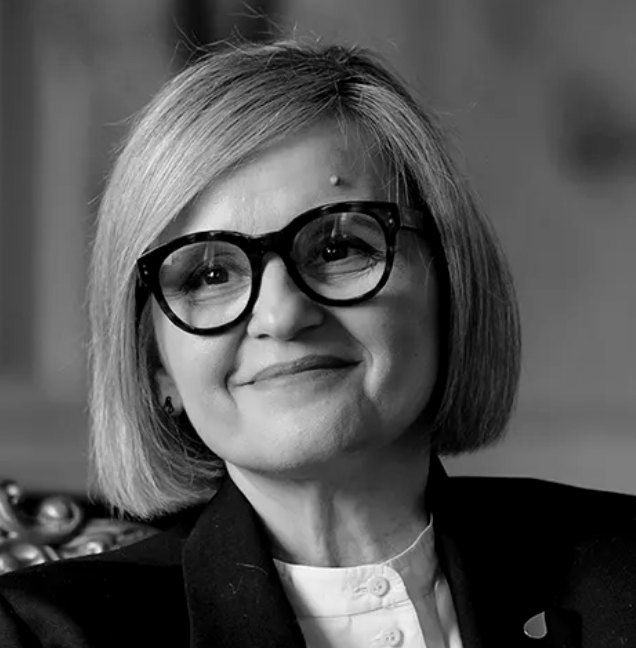
Snježana Prijić-Samaržija is a Full Professor at the Department of Philosophy, Faculty of Humanities and Social Sciences, University of Rijeka. Her research interests include social philosophy, political epistemology and applied ethics, particularly questions relating to gender equality. She was among the founders of the Department of Philosophy at the Faculty of Humanities and Social Sciences and served as its first Head. She was the first Director of the University of Rijeka Foundation and is one of the founders and directors of the Centre for Advanced Studies Southeast Europe. Before serving two terms as Rector, she spent eight years as Vice-Rector for Students and Studies. Over sixteen years of active involvement in the governance of the University, she has been, and continues to be, a member of numerous European governing bodies and projects, including those of the Council of Europe and the European University Alliance, as well as an expert in numerous national and international bodies concerned with higher education and science. Prijić-Samaržija has a particular interest in the democratic mission of universities, the civic mission of education and science, and strategies for transnational and cross-sectoral university cooperation in the context of future challenges. Her most significant achievements in the field of gender equality include the adoption of the first Gender Equality Plan in Croatia and the establishment of the Gender Equality Council at the University of Rijeka. She currently serves as Rapporteur for Gender Equality to the Council of Europe’s Steering Committee for Education.
Ivana Tutić Grokša

(Zagreb, 1992) holds a Master’s degree in Social Work and a doctorate in the field of social work. She obtained her doctorate in 2024 from the University of Zagreb Faculty of Law, Department of Social Work, with a dissertation on minority stress and the mental health of transgender people. Her primary research interests include the social position and well-being of transgender people and gender minorities, as well as the position of minority and vulnerable groups within the healthcare system and society more broadly. From 2016 to 2020, she worked as a social worker within the social welfare system, and from 2020 to 2024 as a teaching and research assistant at the Department of Social Sciences and Medical Humanities, Faculty of Medicine, University of Rijeka. In addition to her academic research, she is engaged in professional work at the “Novi život” Club for Treated Alcoholics in Rijeka.
External Associates
Ana Ajduković

(Pula, 1991) obtained her Master’s degree in 2016 from the Department of Cultural Studies, specialising in Media Studies and Popular Culture. She worked as an administrator and expert associate at the Centre for Women’s Studies at the Faculty of Humanities and Social Sciences in Rijeka. Since 2017, she has been an external associate on the European Capital of Culture project, within the “Campus 27 Neighbourhoods” programme strand, and is a member of the KKT Executive Board. She is employed by the Lesbian Organisation Rijeka (LORI). Her interests include feminism and activism. She is one of the coordinators and organisers of the Cinema Classroom programme.
Jana Ažić

(Rijeka, 1988) is a graduate in Cultural Studies. During the 2011/2012 academic year, she completed the educational programme of the Centre for Women’s Studies in Zagreb. Until 2017, she was employed at the University of Rijeka, where, alongside her work on other cultural and lifelong-learning projects, she organised feminist workshops as part of the project Community Values from the Perspective of the Social Sciences and Humanities. She actively participates in the Cinema Classroom programme and other programmes organised by the Centre. She has published several works on feminist topics and engages in dramatisation and critical inquiry.
Greta Grakalić Rački

(Zagreb, 1990) is a graduate theologian and cultural studies scholar who lives and works in Rijeka. She is a passionate campaigner against interrupting others and an advocate of women’s solidarity. She was an external contributor to Zarez, writing about new technologies, God and cyborgs. She has extensive experience in drama, which she makes ample use of in everyday life. She worked as an expert associate at the Centre for Women’s Studies at the Faculty of Humanities and Social Sciences in Rijeka and was one of the organisers of the Cinema Classroom programme. She is currently employed by SOS Rijeka – Centre for Nonviolence and Human Rights.
Marija Katalinić

Marija Katalinić is a researcher and curator whose work focuses on the interdisciplinary study of gender, memory and film within the broader field of visual culture. She obtained her doctorate in 2023 from the Institute for Cultural Research at Humboldt University of Berlin. She is active in the field of documentary film through curatorial, programming and moderating work, as well as collaborations with partners such as Art-kino Croatia and Balkan Film Week in Leipzig. She also has experience in managing European cultural projects and previously served as Co-Director of the International Association for Visual Culture (IAVC). Her work focuses on understanding the ways in which culture is distributed and experienced, with the aim of promoting democratic values through theory and practice.